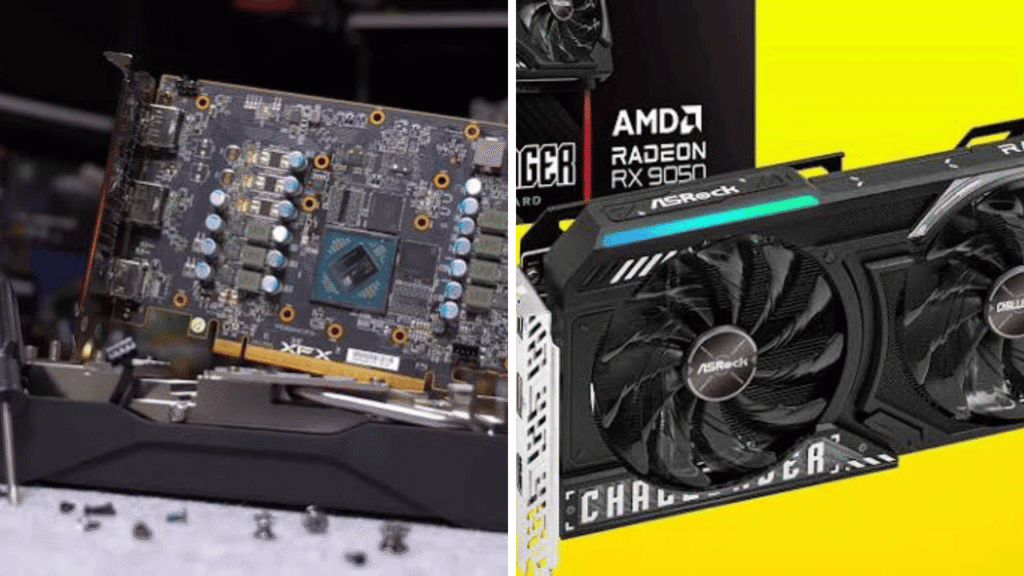
AMD Radeon RX 9050 4GB Performance Trails 8GB Model by 37% in Benchmarks
AMD Radeon RX 9050 4GB Performance
The AMD Radeon RX 9050 4GB is showing a large performance gap compared to the 8GB version in fresh gaming benchmarks. In tests involving 18 titles, the 8GB Radeon RX 9050 averaged 107 frames per second at 1080p Low, whereas the 4GB card could hit 78 FPS.
That makes the 8GB version around 37% faster on average in the games we tested. The results also show that AMD’s 4GB variant is not just an RX 9050 with less VRAM, its memory subsystem has also been drastically downsized.
Radeon RX 9050 4GB or 8GB: What’s the difference?
Both graphics cards have the same core configuration and are named Radeon RX 9050, but they differ in memory specifications.
| Specification | RX 9050 4GB | RX 9050 8GB |
|---|---|---|
| VRAM | 4GB GDDR6 | 8GB GDDR6 |
| Memory bus | 64-bit | 128-bit |
| Memory speed | 18 Gbps | 18 Gbps |
| Memory bandwidth | 144 GB/s | 288 GB/s |
| Stream processors | 1,024 | 1,024 |
| Boost clock | Up to 2.6 GHz | Up to 2.6 GHz |
| Target market | OEM systems | Retail/OEM |
So the 4GB model has half the VRAM, half the memory bus width and half the memory bandwidth of the 8GB model. The test reporting also states that the 4GB card features a cut-down Infinity Cache configuration.
RX 9050 4GB Benchmarks Indicate 37% Gap
Hardware Unboxed put the two models to the test across 18 titles at 1080p Low settings. The outcomes were:
| Test | RX 9050 4GB | RX 9050 8GB |
|---|---|---|
| 18-game average | 78 FPS | 107 FPS |
| 1% lows | 55 FPS | 78 FPS |
| Lowest tested settings | 111 FPS | 147 FPS |
| 8GB advantage | — | 37% average |
Even with graphics settings turned down further, the 8GB model was still well ahead. At the lowest tested settings it averaged 147 FPS compared with 111 FPS for the 4GB version, leaving an approximately 32% difference.
Some games show an even larger performance gap
The average result is only part of the tale. Some of the individual titles showed a significantly greater disparity between the two Radeon RX 9050 configurations.
| Game | Reported 4GB vs 8GB difference |
|---|---|
| 007: First Light | Up to 53% |
| Forza Horizon 6 | Up to 47% |
| Assassin’s Creed Black Flag Resynced | Around 46% |
| The Last of Us Part II | Around 31% |
| Fortnite | Around 21% |
| Cyberpunk 2077: Phantom Liberty | Around 8% |
This variation reveals that the effect is strongly game-dependent and memory-dependent. Some titles show virtually little difference, others are substantially more sensitive to the lowered memory configuration.
RX 9050 4GB Why is it so much slower?
The RX 9050 4GB isn’t only slower because it has less VRAM .
The 4GB model has a 64-bit memory interface, and the 8GB version has a 128-bit memory interface. This cuts its memory bandwidth from 288 GB/sec to 144 GB/sec. According to reports, the Infinity Cache has also been halved from 32MB to 16MB according to AMD’s own specs.
This means less room for game objects on the GPU and also a smaller path for transmitting data between GPU and memory.
Memory Config Comparison
| Memory feature | RX 9050 4GB | RX 9050 8GB |
|---|---|---|
| VRAM capacity | 4GB | 8GB |
| Bus width | 64-bit | 128-bit |
| Bandwidth | 144 GB/s | 288 GB/s |
| Infinity Cache | 16MB | 32MB |
| Overall memory configuration | Reduced | Full configuration |
When comparing AMD graphics cards, this is significant since two GPUs with the same product name can produce different results if their memory configurations are substantially different.
The RX 9050 4GB is a graphics card for OEMs only
Availability is another key detail. The Radeon RX 9050 4GB is not a standard retail graphics card that you can buy on its own. The 4GB variant, according to reports, is being targeted by AMD at OEM systems, so consumers are more likely to find it within a prebuilt PC.
That makes the rest of the PC especially crucial.
Testing by Toasty Bros found the OEM system also had a Ryzen 5 5500 CPU and only 8GB of single-channel DDR4 memory with the 4GB card. In some of the tests, moving the graphics card to a more powerful system with a Ryzen 5 9600X and 32GB of DDR5 increased performance.
What to Look for in an RX 9050 Gaming PC
| Check | Why it matters |
|---|---|
| GPU memory | Make sure the system has the 4GB or 8GB version you expect |
| Memory bus | 64-bit and 128-bit configurations perform differently |
| System RAM | Low or single-channel RAM can create additional bottlenecks |
| CPU | A weaker processor can limit GPU performance |
| Storage | Check whether the system uses an SSD |
| Power supply | Important for overall system configuration |
RX 9050 4GB vs. Intel Arc B570
In the benchmark results, the 4GB Radeon RX 9050 is also in an interesting place in relation to Intel’s Arc B570.
In the test provided by Low Setting, the RX 9050 4GB averaged 78 FPS, whereas the Intel Arc B570 averaged 112 FPS. This left Intel’s card 44% ahead of the 4GB Radeon in that particular test.
But this is a benchmark comparison, not a ranking of global performance. Results may differ based on the games, drivers, CPU, RAM setup, and graphics settings being tested.
Benchmarking the RX 9050 4GB and What It Means for PC Buyers
New benchmarks for the RX 9050 4GB highlight why purchasers should check the specific GPU configuration within a prebuilt PC, rather than just trusting the product name.
Both the 4GB and 8GB models are branded as the Radeon RX 9050, however they have very different memory configurations. That came out at 78 FPS in the 18-game test, compared 107 FPS at 1080p Low.
For anyone researching a cheap gaming PC, examining VRAM, memory bandwidth and the rest of the system characteristics might be as vital as checking the GPU name.
Frequently Asked Question
- How much faster is the 8GB RX 9050 vs the 4GB?
The 8GB version achieved an average of 107 FPS compared to 78 FPS for the 4GB version in the stated 18-game 1080p Low test, indicating a ~37% performance boost for the 8GB device.
- Is the RX 9050 4gb the same gpu as the 8gb?
Both cards are called the Radeon RX 9050, and share the same core configuration, but have quite different memory configurations.
- Does RX 9050 4GB feature 64-bit memory bus?
For sure. The 4GB version is equipped with a 64-bit memory interface, and the 8GB version comes with a 128-bit interface.
- Does the RX 9050 4GB have a dedicated graphics card?
Current reports indicate that the 4GB model is for OEM/prebuilt systems, and not conventional standalone retail sales.
- What is the VRAM capacity of the Radeon RX 9050?
The Radeon RX 9050 is available in both 4GB and 8GB depending on the system and model.
Bottom Line
Latest AMD Radeon RX 9050 4GB benchmarks show a way bigger performance differential than the product name would imply. The 4GB model averaged 78 FPS, whereas the 8GB version averaged 107 FPS across 18 titles at 1080p Low.
The main difference is not just the VRAM size. The 4GB card has a 64-bit memory bus and 144 GB/s bandwidth compared to 128-bit and 288 GB/s on the 8GB card.
So, while buying an RX 9050 gaming PC, it is important to verify if the system comes with a 4GB or 8GB configuration.
References
- VideoCardz – Hardware Unboxed and Toasty Bros’ RX 9050 4GB testing coverage.
- Radeon RX 9050 4GB vs 8GB benchmark difference analysis – ComputerBase
- Radeon RX 9050 8GB Review & Benchmark Coverage – TechSpot
read also: Valve Steam Frame VR Headset Brings Standalone Gaming and Full Steam Library Support